

The whole person.
When I begin getting to know my clients and we're exploring their goals and challenges, I have a keen eye that ADHD is likely just one part of the picture.
This is because ADHD is one of multiple cognitive variations under the 'neurodiversity' framework.
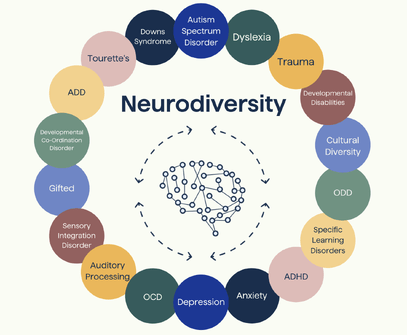
Neurodiversity refers to the natural and valuable variation in the human population. The entire world is neurodiverse, in that no two minds are the same.
But for some of us the differences can be much more pronounced, and when this is the case, the person is neurodivergent.
Some one who is neurodivergent tends to do some things really well - possibly exceptionally well - but can find other things very hard. The experience of extremes can be difficult at best, disabling at worst. Especially if the hard things are perceived as simple tasks.
Here's an example. Let's meet Jane, who has reached out to me at her wit's end.
Jane presents as an exceptional sales executive who achieves her targets but has increasingly been taking more sick days. She was 10 minutes late for the session, highly apologetic, and agitated.
Jane’s team describe her as astute, empathic, fun, and hard working - albeit candid to the point of tactless at times. A past boss described her as a real trailblazer, with a curious mind, always looking for better, more efficient ways to do things.
In a recent performance review, Jane’s boss commented that her excellent verbal communication skills were not reflected in her written work. They also picked up an irritability in her since the recent office move.
Jane feels overwhelmed by her increasing unread emails and meeting deadlines. Staying up late at night in order to keep on top of the workload is something she's always done but is now finding this increasingly taxing.
Her reason for exploring coaching is because she’s doesn't know how else to do her role, she feels stressed when given feedback, and towards the end of the session, she discloses that “I can’t seem to keep it together anymore” afraid she’s heading towards burnout.
Jane demonstrates some common strengths and difficulties as a neurodivergent professional.
We're seeing executive functioning challenges: consistently late, overwhelm with routine tasks and prioritising, difficulty with written communication despite strong verbal skills.
We're seeing sensory sensitivity showing up in the irritability since the office move.
We're seeing a pattern of compensating through overwork like the late nights, the sick days, the pushing through, hallmarks of someone who has been masking for a long time.
But what I also notice is that Jane's strengths are just as pronounced as her difficulties. Her empathy, her drive for efficiency, her verbal brilliance, her big-picture thinking. These aren't separate from her neurodivergence at all, they're part of the same wiring.
This is why I say it's seldom just ADHD.
Jane may well have ADHD. But she may also have dyslexia, which would help explain the gap between her verbal and written communication.
The sensory reactivity to the office environment might point toward autism traits, or sensory processing differences. The pattern of high performance followed by crash is consistent with several overlapping profiles.
This is what's known as co-occurrence, or sometimes called "co-morbidity," though I prefer to move away from that language because it implies something is wrong, when often what we're seeing is simply a more complex neurological profile.
Research suggests that around 50–70% of people with ADHD have at least one co-occurring condition. Common companions include dyslexia, dyspraxia, autism, anxiety, and mood dysregulation. For many of my clients, getting an ADHD diagnosis in adulthood was the first lever, and understanding the fuller picture takes time, curiosity, and someone willing to look beyond the label.
So what does this mean for Jane, and for coaching?
It means we don't start by trying to fix the emails or the lateness. We start by understanding Jane. What does her brain need so that she can move forward? What does her nervous system need so that it can feel safe enough to disengage? What does her body need so that she can accomplish her tasks sustainably? Where does she thrive, and what conditions create that? What has she been doing to cope, and at what cost?
Coaching with a neurodiversity lens means holding the whole person - their strengths, challenges, history, and context - and working from there.
Jane doesn't need to be fixed. She needs a map that actually reflects the terrain she's navigating. And that, in my experience, changes everything.